Here it is in English, for all of you who follow my work from around the world. – Judit
I have an old friend who paints with wine. Not wine bottles, not bunches of grapes, but with wine itself, as if it were paint. She mixes real wine with soil from the vineyard, and this wine paste later becomes a picture. Judit Nagy L. was born in the Hungarian-speaking south of Slovakia and became a civil engineer. Then, on her fortieth birthday, she set off on foot for Santiago de Compostela. She came back a painter.
Today she lives in Switzerland, near Zurich. Her paintings have been shown in many exhibitions and museums, and she has written two books – one of them, CORPUS HERMETICUM (Másként), is still awaiting publication. Next year the Arena Zabatkiensis Order of Wine Knights (Vinski viteški red „Arena Zabatkiensis”), the oldest registered wine order in Serbia (registered on 22 January 2001), will make her its ambassador.
This is Judit’s story, the way I would tell it over a cup of coffee.
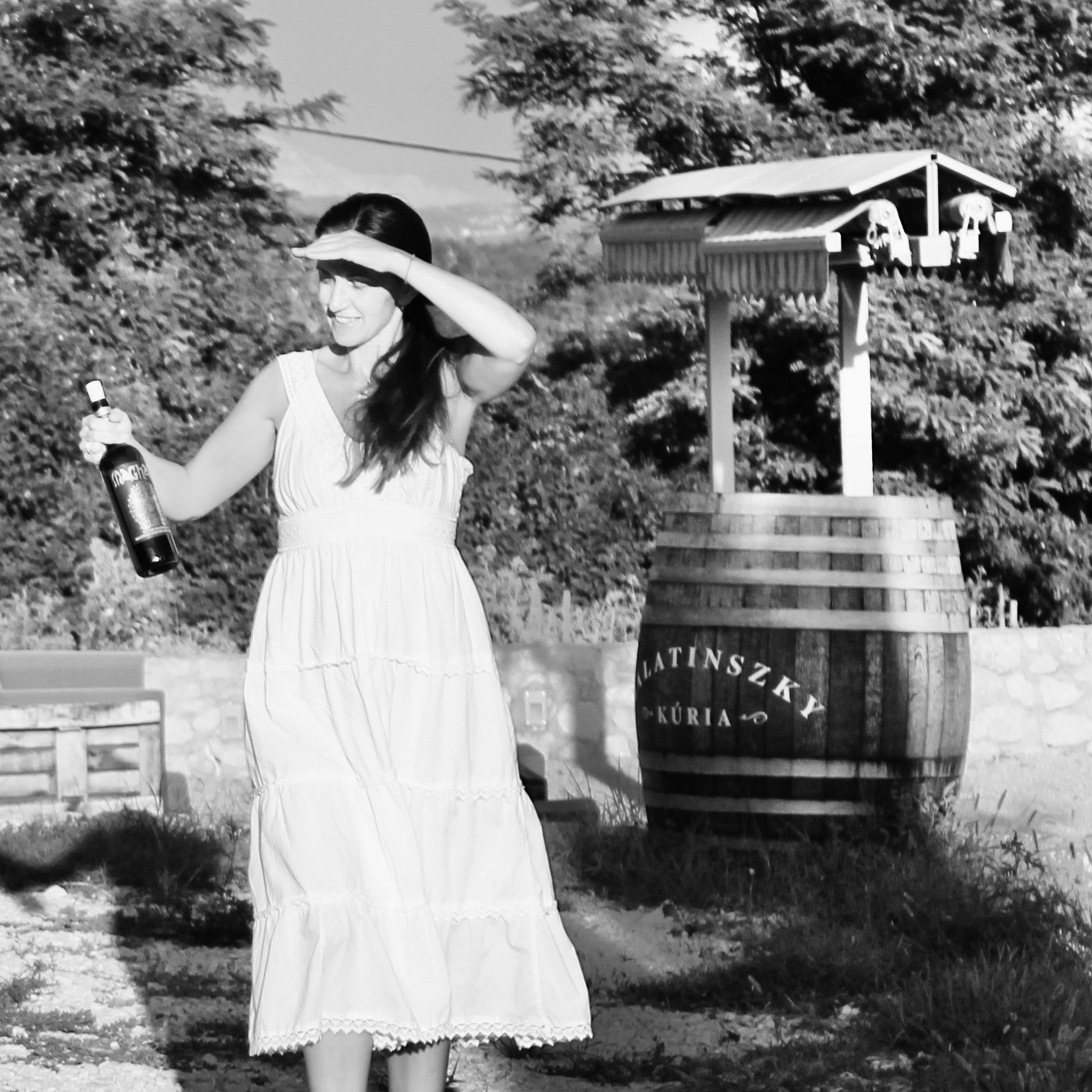
Judit Nagy L. in Villány, Hungary, at the Malatinszky Kúria winery
The little girl who built villages out of clay
Judit was born in 1971 in Hurbanovo (Ógyalla in Hungarian), in the Komárno district, and spent her early childhood in a small village, Búč (Búcs), in the heart of Slovakia’s Hungarian community. Her Hungarian mother tongue still matters to her – she writes her books in Hungarian, even though she has lived in a German-speaking environment for more than ten years. If you ask her where and when painting began, she doesn’t name an art school but the kindergarten in Búč. She was five when her teacher noticed that this child didn’t draw like the others. She built villages out of clay, designed objects from paper, plasticine, textile and leather, and as a child her name was already on the list of winners of a national youth drawing competition.
She attended the art school in Komárno alongside grammar school, local painters took her under their wing, and by the age of 17 the plan was set: the art university in Budapest.
Life had other plans, as it so often does.
The engineer who always felt something was missing
Instead of becoming an artist, Judit became a civil engineer. She earned her master’s degree at the Faculty of Architecture in Subotica, then still Yugoslavia – in Serbo-Croatian, of course. She worked as an engineer, started her own business and raised a family. From the outside, everything was in order. Looking back on those years, Judit says she always lived with a sense that something was missing, but recognising it, admitting it and saying it out loud felt almost impossible.
Meanwhile she tried to stay part of the art world: during her university years she belonged to a private studio and school, and took part in group exhibitions. This double life defined her until her technical studies took all her strength. For a while you can live with your talent filed under “hobby”. For a while.
Forty, with a backpack, in Spain
In 2011 she turned forty, and as a birthday present to herself she chose the Camino. Not a weekend stretch, but the long version of the Way of St James: more than a month of walking through three Spanish wine regions – Rioja and Navarra, Castile and León, and finally Galicia. In the evenings she tasted the local wines with her fellow pilgrims, although until then Judit had lived as a teetotaller and knew nothing about wine, even though her ancestors had made their own.
According to Judit, two things happened there at once, and they have shaped her whole life since. She fell in love with wine, and she fell in love with a man. Stefan has been her husband ever since, and her manager too.
And here, on the pilgrimage, the third thing happened as well, the one that is hardest for her to talk about. On the Camino she decided that she would never again deny who she was. That she is a painter, born one, and will stay one. Judit calls those six weeks a “catalyst”. I would rather say she found her way back to the Judit who once saw the door of the Komárno drawing studio close behind her.
“I am an artist because I was born one. My artistic work is an act of reconciliation.”
– Judit Nagy L.
How wine becomes paint
The idea of painting with wine came soon after the Camino, and it took years to turn it into a working method. Judit consulted chemists, winemakers and painters, and in 2015 she worked a whole year at a winery in Neftenbach, near Winterthur, to understand the material from the inside. That same year saw the birth of what she calls the In Vino Veritas Art method, or IVVArt for short.
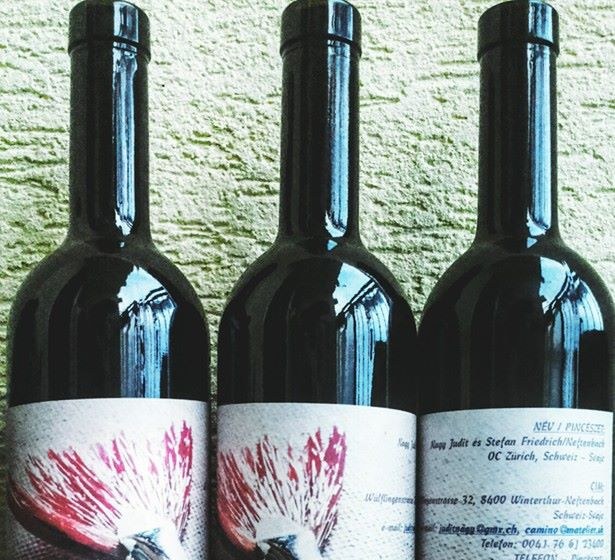
Neftenbach, 2015: Judit and Stefan’s own Cabernet Jura
The essence is simpler than you’d think, and more complex than it sounds. Judit mixes real wine with soil from the vineyard – the very soil in which that wine’s grapes grew – and makes a paste that fixes the substance of the wine in the painting. She works with Swiss gouache paints treated with bioresonance information and highly pigmented acrylics, and crystals, pearlescent paints, feathers, shells or pieces of mirror often find their way into the picture too.
She says the terroir carries everything that shapes a wine’s character: the sun, the water, the air, the moon with the stars, and human work – all of it belongs there. A handful of soil tells more about a wine’s character than any description – at least for Judit.
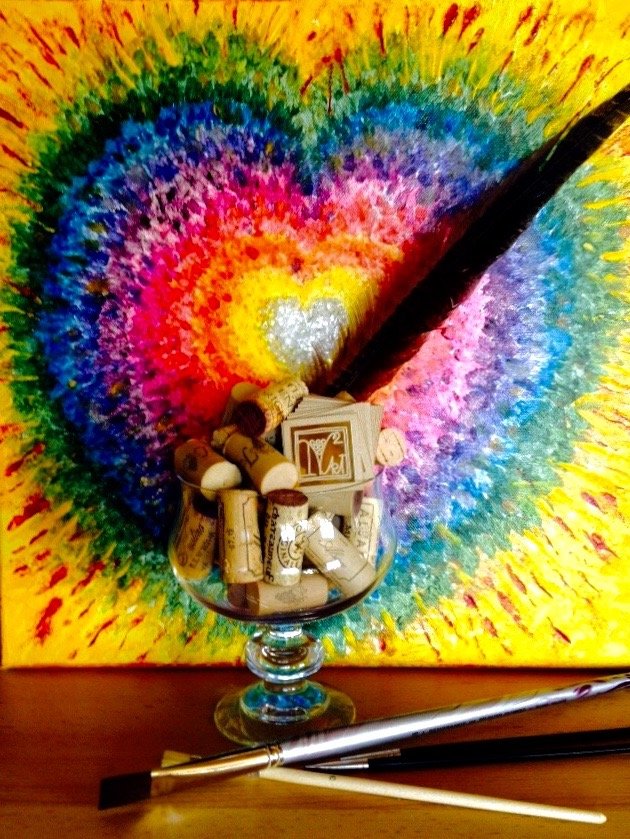
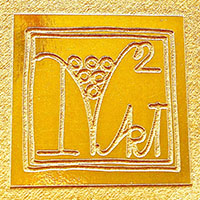
The IVVArt emblem: heart, corks, brushes
Her most important genre is the WINEporTRAIT – in Hungarian, BORarcKÉP, a play on bor (wine) and arckép (portrait). It is never an illustration, but the portrait of one particular wine: Judit tastes it, listens inward, and paints what the wine sets in motion within her. Each painting belongs to a single wine, and its certificate of authenticity carries every detail of that wine, vintage and winery included. She works in two ways: sometimes she paints spontaneously after tasting, and sometimes she waits for months for a wine that fits a story already in her head. Both paths are full of wonder.
“Wine is truth. I want to touch the viewer’s heart and soul with warmth.”
– Judit Nagy L.
A Cabernet Franc from Villány, in runic script
Ask her which of her paintings matters most, and she names the first one: the wine portrait “Brother Sun, Sister Moon”, which she considers the alpha and omega of her career, even though her technique has long since grown beyond it.
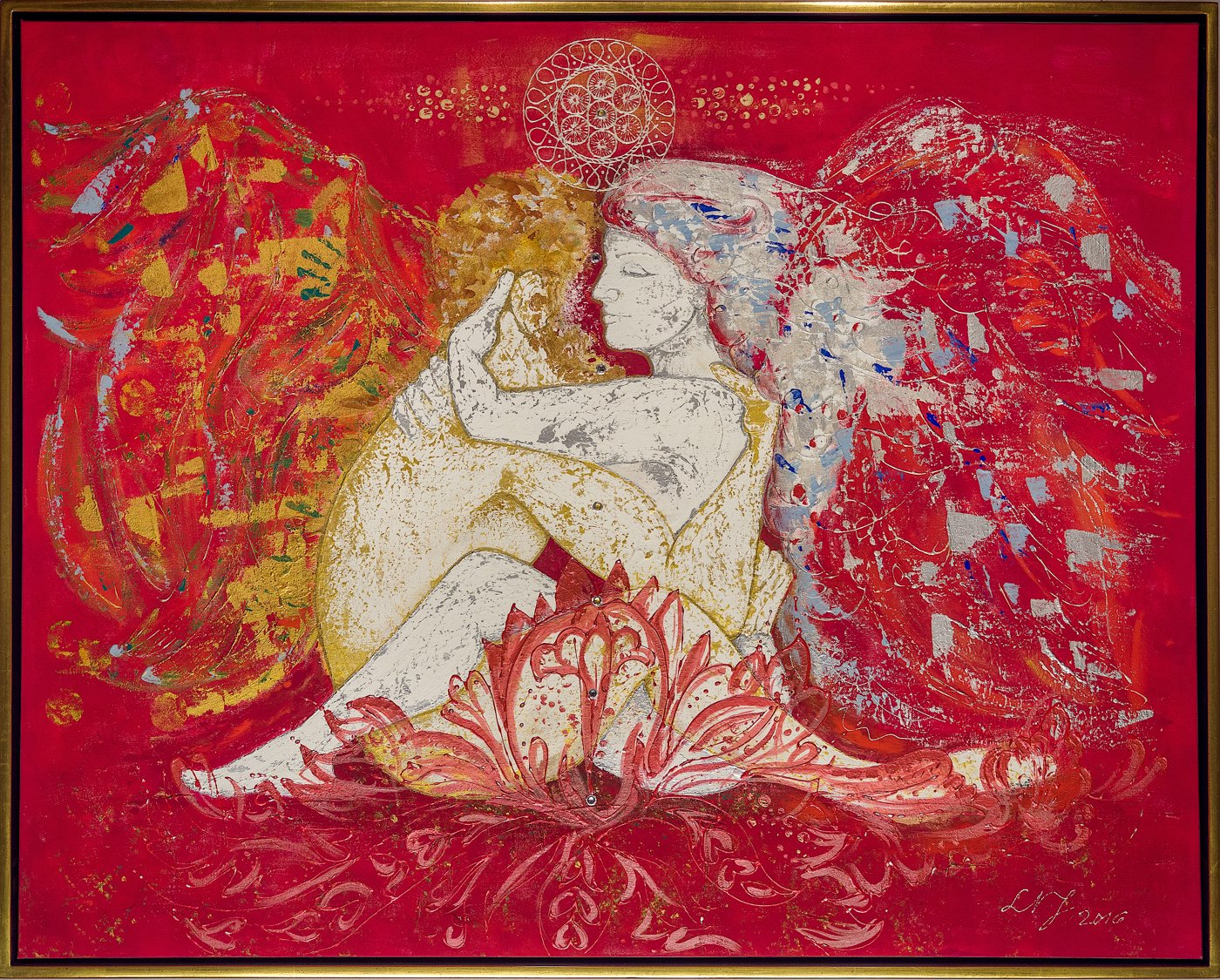
“Brother Sun, Sister Moon” – WINEporTRAIT, 100×80 cm
I have a different favourite, though, and not by chance. In 2017 Judit visited a winery in Villány, took a soil sample from the vineyard, and two years later it became “MAGHARI” – the portrait of a Cabernet Franc from Villány, 150 centimetres wide, its title painted in gold gouache in Hungarian runic script. This painting is not for sale. A Hungarian painter from Slovakia, living in Switzerland, painting with a Hungarian wine in Hungarian letters. There is no more precise way to sum up where she comes from.
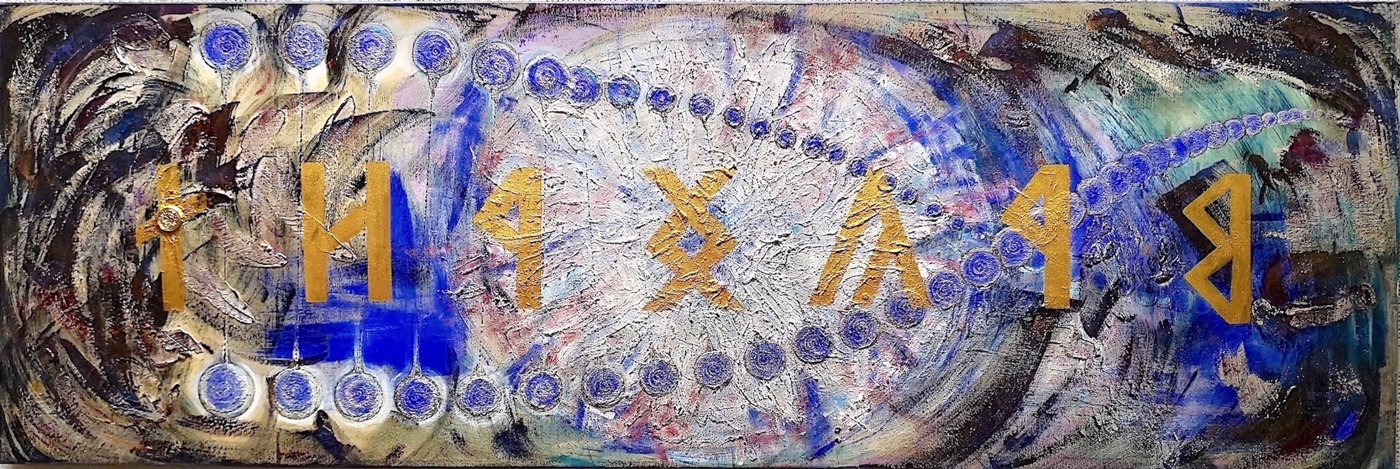
“MAGHARI” – WINEporTRAIT, 150×50 cm, title in runic script, gold gouache
Then there is Etna. In May 2022 she spent three weeks at an artist residency in Sicily, at the foot of the volcano. She visited the Passopisciaro winery, gathered the volcanic soil with her own hands, and while tasting the 2019 Passorosso, Beethoven’s Fifth Symphony came to her mind. The result was “Sempre Vivo”, a 120×90 cm night-time eruption with stars, in a gilded frame. She also painted the “Message in a Bottle” wine of Il Palagio, the Tuscan estate of Sting and his wife Trudie Styler – the painting, naturally, is called “My Message in a Bottle”. And spirits have since joined the wine: in the “Spirit of Art – Art of Spirit” series she paints with gin and raspberry brandy, using botanicals brought from the distillery.
From Lennon’s curator to the Neftenbach Wine Museum
Anthony Fawcett, the British art critic, curator and writer – who worked closely with John Lennon and Yoko Ono as their personal and curatorial assistant from 1968 to 1971 – wrote a dedicated essay on Judit. In it he uses the Roman idea of the “genius loci”, the spirit of a place, to describe how Judit carries the soul of a wine region onto the canvas.
Judit has exhibited in Dubai, Venice, Barcelona, Sanremo and Switzerland, and in 2024 a Budapest gallery represented her for a year. She has a permanent exhibition in her studio in Pfungen, Switzerland, and from autumn 2025 the Neftenbach Wine Museum hosted her exhibition “WINEporTRAIT-e” – in the very village where she had worked at the winery ten years earlier. At the opening of the solo show, the laudation was given by Dr. Martin Barak, CEO of the Louis Roederer champagne house in Switzerland. A beautiful circle closed there.
She speaks fondly of her creative week in Budapest, when, at the invitation of sculptor János Megyeri, they set to work together. Judit incorporated the three sculptural works into her own 21-piece painting series.
For this year’s Valentine’s Day, she and her husband created SHAKANA, a series of seven handmade heart-shaped works. The heart is the universal sign of love in all its shades, and they intend the series not as decoration but as a “tool” for self-care. It is no coincidence that by then her blog was no longer about wine, but about how it is time for us to treat one another as adults, with respect. “Enough is enough”, she writes. What the world needs is not selection by exclusion, but solidarity and understanding.
“He who is with me gathers; he who is against me scatters.” – Jesus
The dandelion that couldn’t choose
Judit’s favourite motif is the dandelion, and if I had to describe her in one sentence, I would do it with a tale she herself likes to share alongside her dandelion paintings. The Creator sends angels to the flowers to ask what they want to be. Most flowers want to be the most beautiful, the brightest or the biggest. The dandelion, however, cannot decide: it wants to resemble the Sun, the Moon and the morning stars too. In the end the angel tells it: so be it. First it will shine sun-yellow, then turn mysteriously white like the Moon, and then scatter on the wings of the wind like hundreds and hundreds of stars in the sky.
Judit’s comment on this is that it is not “either-or”, but “both-and”.
Hungarian from Slovakia and Swiss.
Wine taster, wine judge and painter all the while.
A wine judge in the literal sense: in 2016 and 2017 she sat on the jury of an international wine competition in Slovakia. She once called herself a “human cuvée”, and I can’t think of a better word for her.
Her signature is worth a word, too. Not simply Judit Nagy, but Judit Nagy L. (L. Nagy Judit in the Hungarian name order), and on her paintings just LNJ. The “L” honours the name of her great-grandfather, who was of French descent – and it also sets her apart from a younger painter from Komárno who is likewise called Judit Nagy, and whose paintings Judit actually collects. Another story that could only happen to her.
“Do your work. Find your voice. Practise self-reflection. Take a break. Start again.”
– Judit Nagy L.’s advice to young artists
Why write about a wine painter in a coffee magazine?
Because what Judit does with wine, we “coffee people” experience every day – we just don’t paint it. She says a wine’s character comes from the soil, the light and human work, and that you understand it by tasting. We say exactly the same about an Ethiopian single origin or a Brazilian natural lot. Terroir, vintage, the mark of the grower’s hand – the same language, just in a different glass.
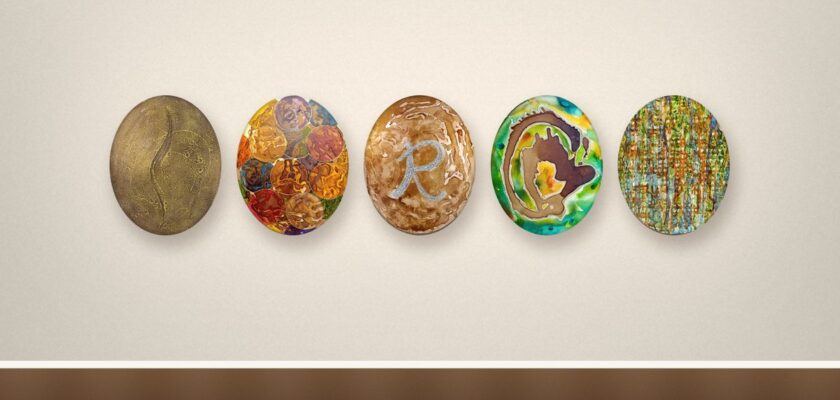
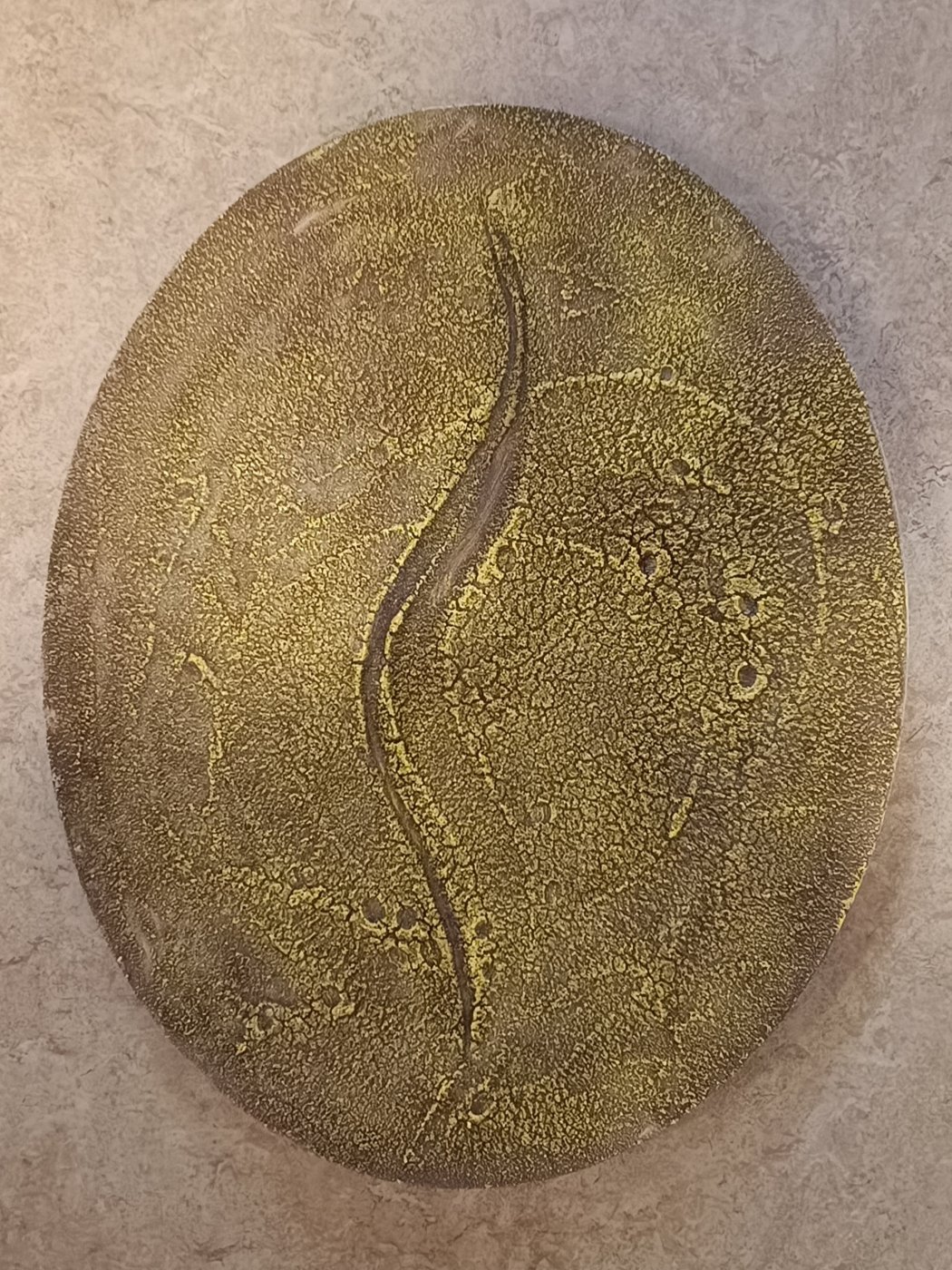
And because I have a much more personal reason, too. Judit once painted for me as well. Not with wine, but with coffee – five oval canvases whose subject is coffee itself. On one, a coffee bean rises out of the canvas, with a gold-dusted, crackled surface, as if fresh from the roaster. On another, eleven colourful circles sit side by side, soaked in brown, like a flavour wheel or a row of tasting bowls on a cupping table. On the third, green, brown and blue run down a lattice-like texture, as if light were filtering through the leaves of a coffee plantation. On the fourth, a brown spiral coils around an orange core, and on the fifth, against a coffee-stained, marbled background, stands a silver R – the initial of a coffee’s name. Can you guess whose?
 World of Coffee
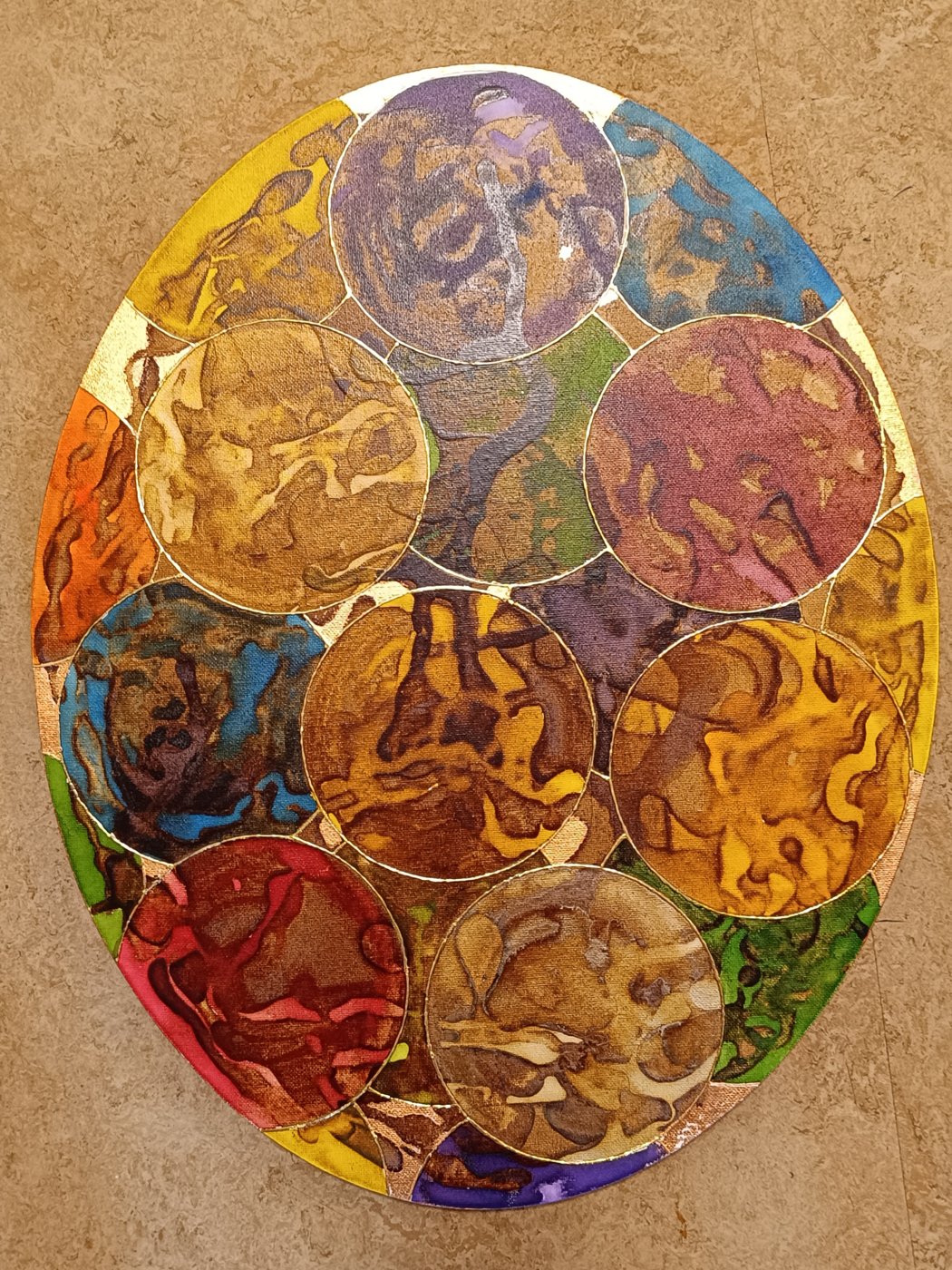 Impressa
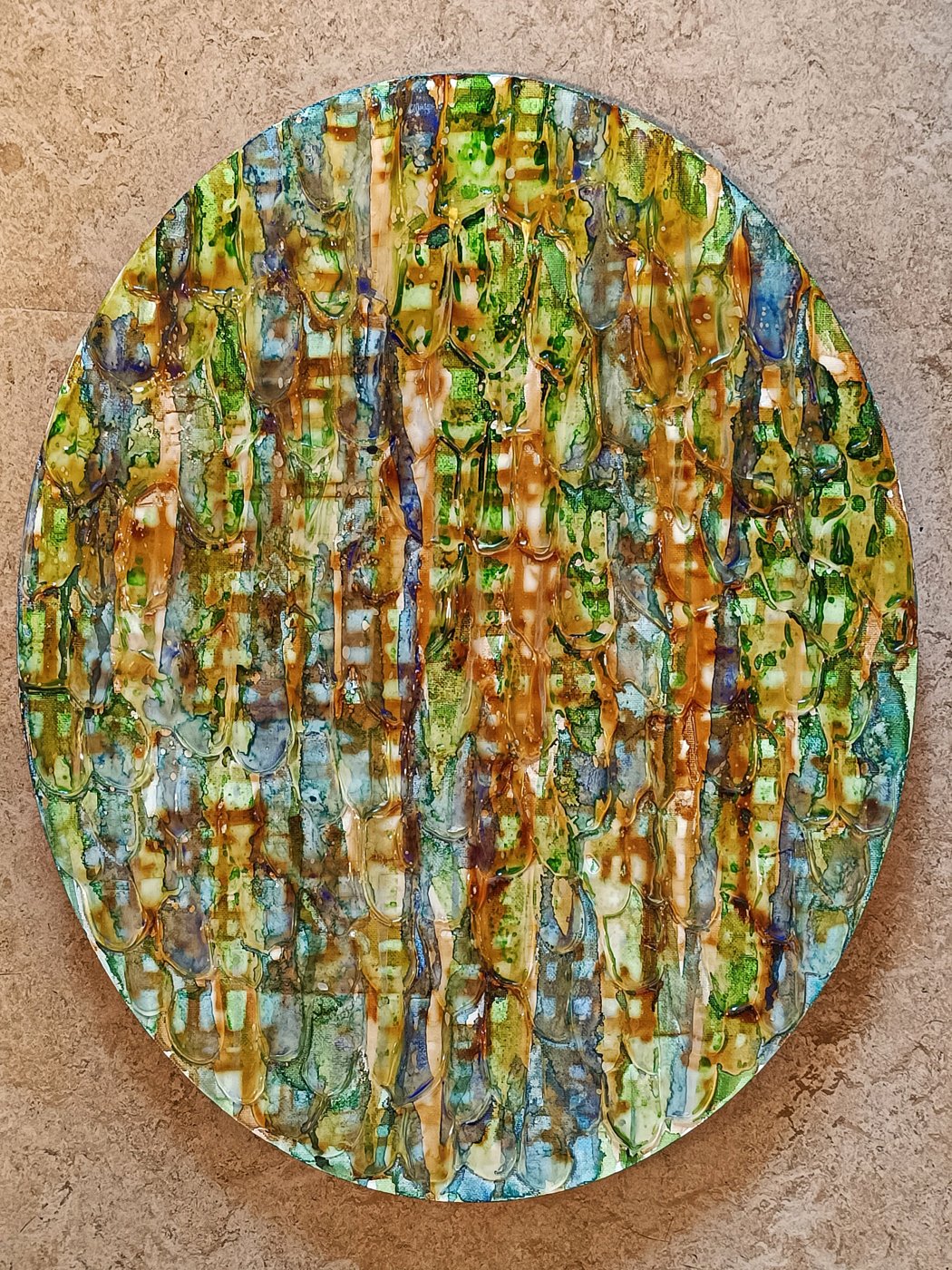 Malabar Monsooned
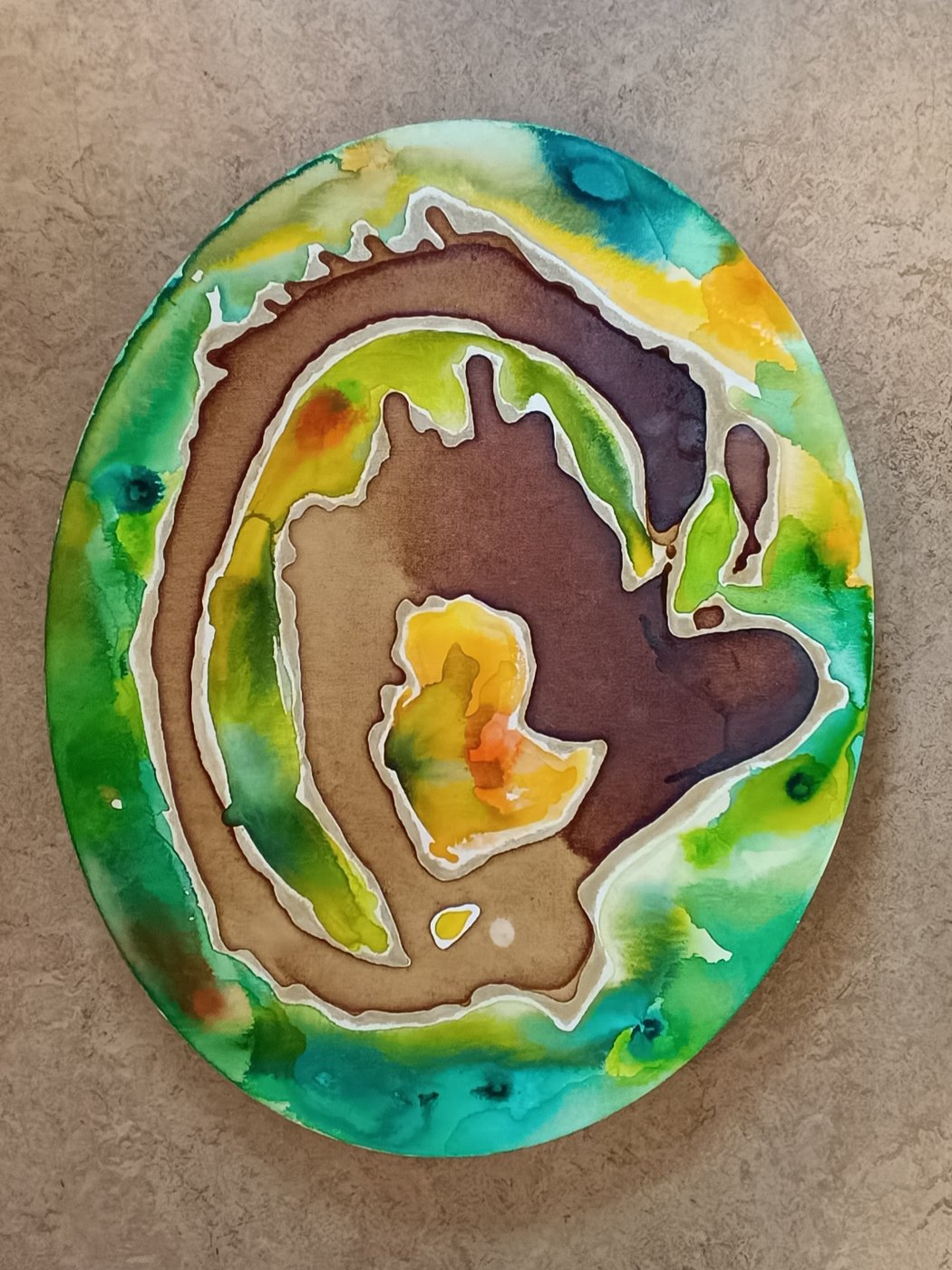 San Antonio
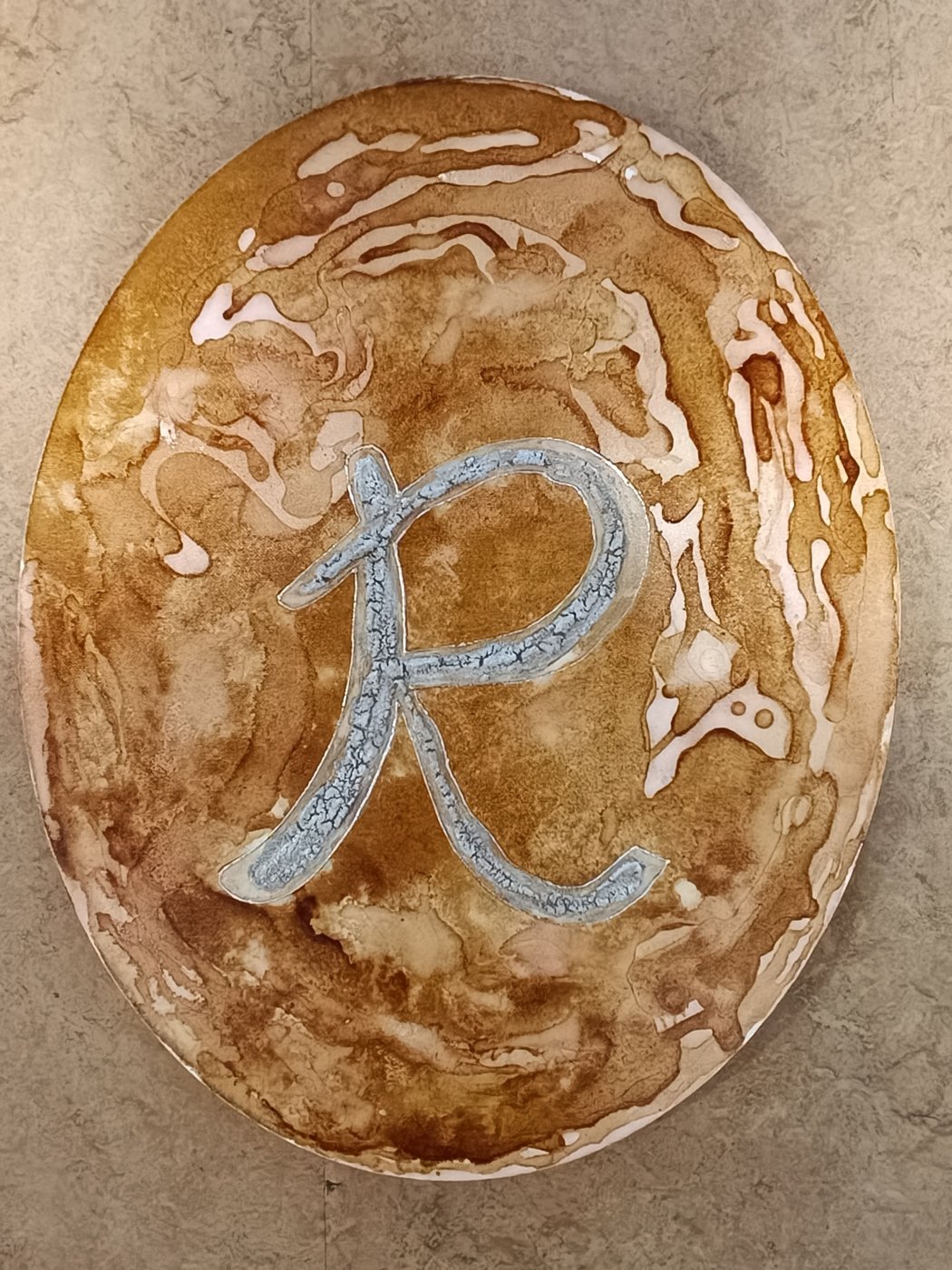 Riguardo
The five oval canvases painted with coffee
These paintings live with me, and I walk past them every day. If anyone wants to know what coffee means to a painter who otherwise works with wine, they only need to look at them: the same soil, the same attention, the same tasting – just a cup instead of a glass.
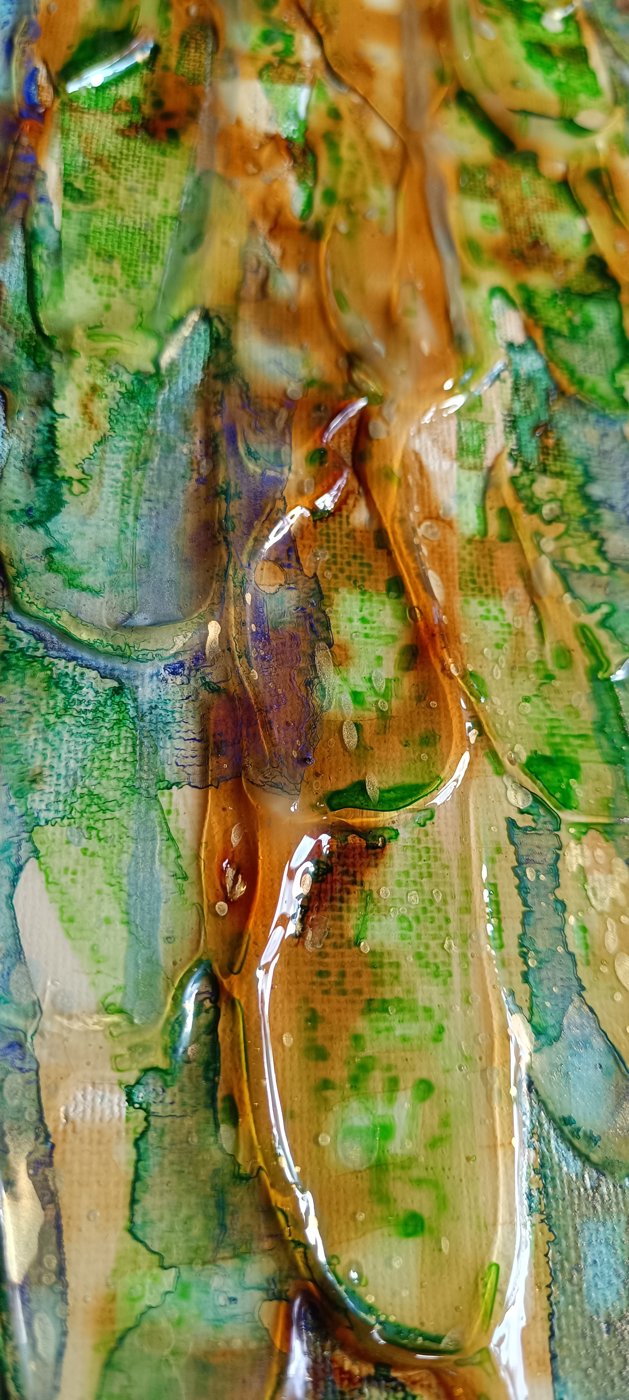
Up close: the layers of coffee on the surface of Malabar Monsooned
And if, after the paintings, you are curious about her words too: Judit’s short story “Cipő helyett eb” (A Dog Instead of Shoes) was published in the women’s section of Kávéház Magazin (in Hungarian).
Read the short story (Hungarian)
Today Judit lives in Freienstein, a small village in the canton of Zurich, with Stefan, who is not only her manager but also her creative partner. She doesn’t follow trends; about NFTs she says that real art must be felt, it cannot be locked into a string of numbers. Her paintings can be seen in the Saatchi Art online gallery, and her thoughts can be read on her own blog, right here on invinoveritasart.com.
Subscribe to her newsletter if you’d like to be the first to hear what is happening in Judit’s studio!
Subscribe to Judit’s newsletter
As for the fact that I look after this very website for her – I only mention it so you know how I come to know her story so well.
Born: 1971, Hurbanovo (Ógyalla, Altdala), Slovakia – Hungarian mother tongue
Education: MSc in civil engineering, Subotica
Turning point: the Camino, 2011, on her 40th birthday
Method: IVVArt (In Vino Veritas Art) – real wine, vineyard soil, bioresonance gouache, since 2015
Home: Freienstein, canton of Zurich, Switzerland (since 2015)
Where to see her work: ivvart.com, saatchiart.com/lnj, Instagram: @l.n.j._art
Originally published in Hungarian in Kávéház Magazin, October 2026. Text: Zoltán Szilágyi.

